

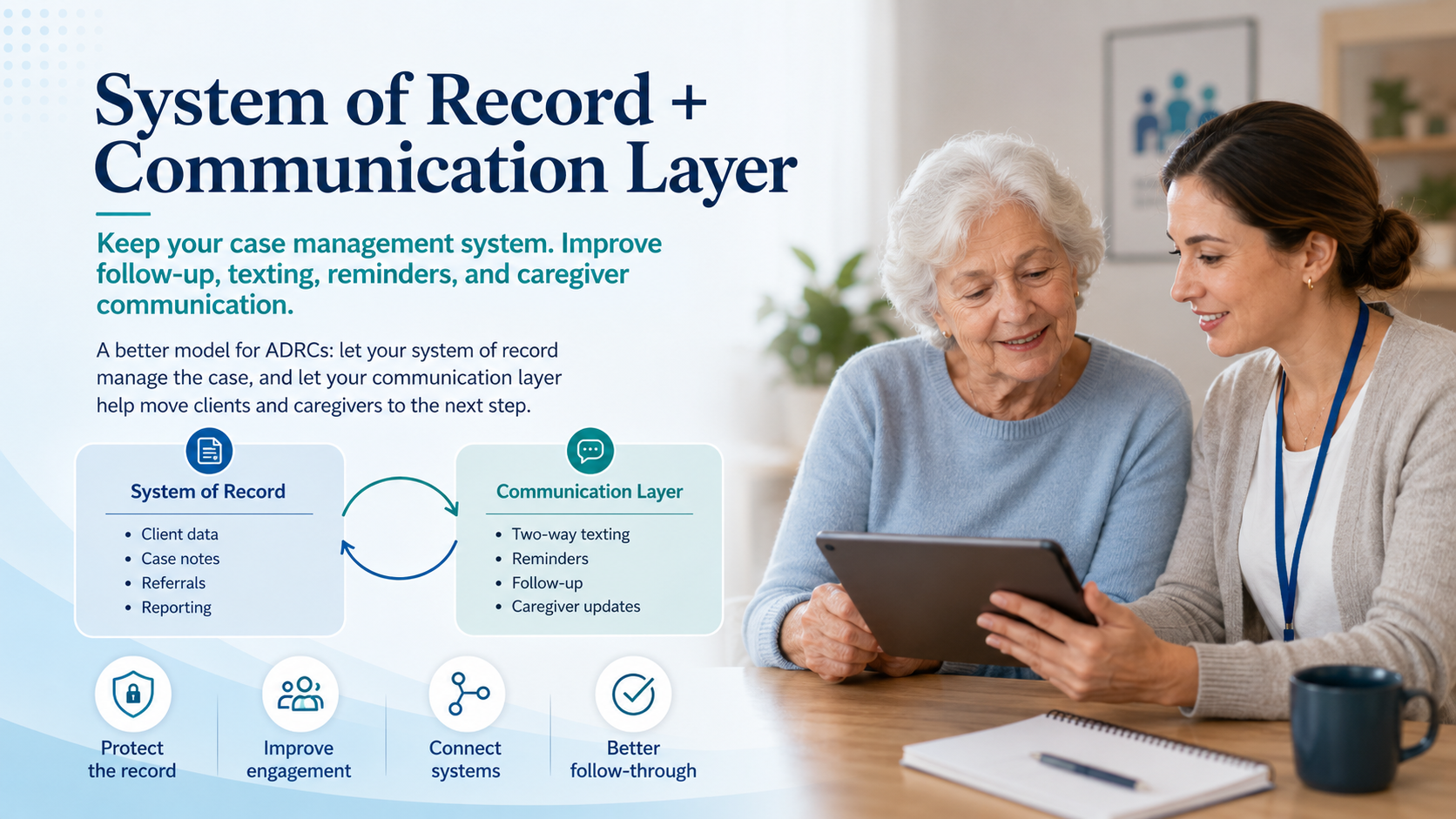
Why ADRCs Need a Communication Layer Separate from Their System of Record
Most Aging and Disability Resource Centers already have systems that do important work.
They may use a case management platform, a referral network, a CRM, a resource database, a state reporting system, or a combination of tools. These systems help document services, track eligibility, manage referrals, support compliance, and report outcomes.
Those systems matter.
They should not be casually replaced.
But there is a common challenge many ADRCs, Area Agencies on Aging, and No Wrong Door programs face: the system of record is not always the best system for communication.
For ADRCs, that distinction matters.
The system of record tracks the work.
The communication layer helps move the work forward.
The System of Record Has a Critical Job
A system of record is designed to store, organize, and protect important information.
It answers questions like:
Who is the client?
What services were requested?
What referrals were made?
What eligibility steps were completed?
What notes were recorded?
What outcomes were documented?
What reporting requirements must be met?
These systems are essential for continuity, compliance, funding, and accountability.
For ADRCs, the system of record may be where staff document intake, referrals, assessments, case notes, service plans, and outcomes. It may also support reporting to funders, state agencies, or partner organizations.
That is a very different job from helping a caregiver quickly confirm an appointment by text.
The Communication Layer Has a Different Job
A communication layer is designed to support real-time engagement and follow-through.
It answers a different set of questions:
Did the client respond?
Did the caregiver understand the next step?
Was the appointment confirmed?
Was the missing document completed?
Did the person connect with the referred provider?
Does staff know which replies need attention?
Can routine reminders happen automatically?
Can urgent messages be routed quickly?
This is not the same as case management.
It is the engagement layer that helps case management succeed.
A case management system can show that a referral was made. A communication platform can help confirm whether the person actually connected.
A system of record can document an appointment. A communication platform can remind the client, receive a confirmation, and alert staff if the person needs to reschedule.
A record system can store the next required step. A communication layer can help the client or caregiver complete it.
Why All-in-One Systems Can Create Friction
It is easy to understand the appeal of one system that does everything.
In theory, a single platform for case management, referrals, outreach, communication, reporting, and analytics sounds efficient.
In practice, all-in-one systems can become heavy, expensive, and difficult to adapt.
For ADRCs, that can create several challenges:
Long implementation timelines
Expensive customization
Rigid workflows
Difficult procurement cycles
Staff training burden
Limited communication flexibility
Dependence on one vendor
Slow response to new outreach needs
More disruption than the problem requires
When the problem is communication follow-through, a full system replacement may be unnecessary.
A separate communication layer gives ADRCs a more practical modernization path. It allows the organization to keep the system of record in place while improving how people are reached, reminded, routed, and supported.
The Better Model: System of Record + Communication Layer
The strongest approach is not replacement.
It is connection.
The system of record remains the trusted home for client data, case notes, referrals, eligibility, and reporting.
The communication layer handles the active engagement that helps clients and caregivers take the next step.
Together, they create a more complete operating model.
The system of record tracks what should happen.
The communication layer helps make it happen.
The system of record stores the case.
The communication layer advances the conversation.
The system of record documents the referral.
The communication layer helps confirm the connection.
The system of record supports compliance.
The communication layer supports responsiveness.
For ADRCs, this separation is especially powerful because it improves the client journey without forcing the organization to rebuild its core infrastructure.
What This Looks Like in Practice
Imagine an ADRC receives a request for caregiver respite information.
The inquiry is documented in the existing case management system. That does not change.
But the communication layer can automatically send a confirmation text:
“Thanks for contacting us about caregiver support. A specialist will follow up soon. Reply 1 if you prefer morning or 2 if you prefer afternoon.”
When the caregiver responds, the message is routed to the right team. If an appointment is scheduled, reminders go out automatically. If paperwork is needed, the caregiver receives a simple follow-up. If the referral is completed, a check-in message can ask whether they were able to connect.
The system of record remains accurate.
The client and caregiver experience improves.
Staff spend less time chasing responses.
Leadership gains better visibility into where communication is helping or where follow-up is breaking down.
Why This Strategy Fits ADRCs and No Wrong Door Programs
ADRCs operate in a complex environment. They often coordinate across public agencies, nonprofit organizations, health systems, Medicaid programs, transportation providers, meal programs, caregiver services, and community-based partners.
No single communication channel or software platform can own that entire ecosystem.
A modular approach is more realistic.
It allows ADRCs to modernize the highest-friction part of the client journey without waiting for a full system replacement. It also allows different regions, programs, or departments to adopt communication workflows at their own pace.
For No Wrong Door models, this matters. The goal is to make access easier across multiple entry points. A communication layer helps support that goal by making follow-up more consistent, visible, and actionable.
What to Look for in a Communication Layer for Case Management Software
A communication layer for ADRCs should be more than a bulk texting tool.
It should support:
Two-way texting
Shared inboxes
Staff assignment and routing
Program-based queues
Automated reminders
Client and caregiver opt-in management
Reusable templates
Reporting on replies and follow-up
Integration with existing systems
Role-based access
Compliance-aware messaging practices
Easy onboarding for non-technical staff
It should also be flexible enough to support different aging services workflows, including options counseling, caregiver support, benefits assistance, transportation coordination, nutrition programs, appointment reminders, and referral follow-up.
Most importantly, it should not try to become the official record unless that is truly required.
The value is in helping people move forward.
Integration Does Not Have to Mean Overengineering
Some ADRCs may eventually want full integration between their case management system and communication platform. Others may begin with simple imports, exports, secure links, or status updates.
Both approaches can work.
The important thing is to define which system owns which responsibility.
A clean model may look like this:
The system of record owns the official client record.
The communication platform owns active conversations and outreach workflows.
The integration layer passes necessary events, statuses, and identifiers between systems.
Sensitive details are handled through secure links or documented directly in the system of record when appropriate.
This keeps the architecture clean and avoids turning the communication platform into a second case management system.
The Strategic Advantage for ADRC Leaders
For ADRC leaders, separating the system of record from the communication layer creates a practical path to improvement.
It reduces the pressure to rip and replace.
It shortens the path to operational value.
It improves the client and caregiver experience.
It gives staff better tools for follow-up.
It creates measurable communication outcomes.
It allows the organization to expand gradually.
This matters because many ADRCs are not looking for another massive software implementation.
They are looking for ways to serve more people, more consistently, without adding avoidable complexity.
A dedicated communication layer helps do that.
Why Pidj Fits This Model
Pidj is built around communication workflows: two-way texting, shared inboxes, routing, campaigns, reminders, automation, opt-in management, and integrations.
That makes it well suited to live alongside the systems ADRCs already use.
Pidj does not need to become the system of record to create value. It can serve as the communication and conversion layer that helps staff reach clients, support caregivers, prompt next steps, and improve follow-through.
The case management system protects the history.
Pidj helps improve the journey.
And for people seeking help, the journey is what matters most.
FAQ: System of Record vs. Communication Layer for ADRCs
What is the difference between a system of record and a communication layer?
A system of record stores official client, case, referral, eligibility, and reporting information. A communication layer manages active outreach, reminders, replies, routing, and follow-up. The system of record documents the work; the communication layer helps move the work forward.
Should an ADRC replace its case management system to improve communication?
Usually, no. If the core problem is missed calls, incomplete follow-up, appointment no-shows, or caregiver communication gaps, a communication platform can often solve those issues without replacing the existing case management system.
Can a communication platform integrate with case management software?
Yes. A communication platform can often integrate through APIs, webhooks, imports, exports, secure links, or middleware. The level of integration depends on the systems involved and the workflow being supported.
Why separate communication from the system of record?
Separating the two allows each system to do what it does best. The system of record manages official documentation and reporting. The communication layer improves client engagement, response, reminders, and follow-through.
What makes Pidj useful for ADRCs?
Pidj can support two-way texting, shared inboxes, automated reminders, routing, campaigns, opt-in management, and communication workflows. For ADRCs, that means Pidj can work alongside existing systems to improve client and caregiver engagement without forcing a full system replacement.