
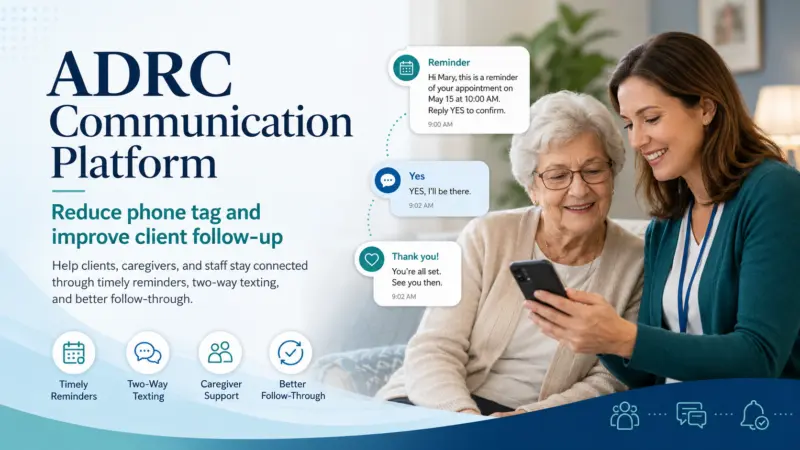
ADRC Communication Platform: Reduce Phone Tag and Improve Client Follow-Up
Aging and Disability Resource Centers are designed to make access easier.
For older adults, people with disabilities, caregivers, and families navigating long-term services and supports, the ADRC is often the first trusted place to turn. The promise is simple: no matter where someone starts, they should be guided toward the right support.
But for many ADRCs, Area Agencies on Aging, and No Wrong Door programs, the hardest part is not identifying the right service.
It is getting people from “I need help” to “I received help.”
That gap is often a communication problem.
A client calls about transportation support but misses the return call. A caregiver submits a request for respite resources but does not know what happens next. A benefits counseling appointment is scheduled, then forgotten. A staff member leaves multiple voicemails about missing paperwork. A referral is made, but no one knows whether the person actually connected.
The result is familiar:
Clients become hard to reach.
Caregivers feel left in the dark.
Staff lose time to repeated call attempts.
Referrals stall.
Intakes remain incomplete.
Appointments are missed.
Outcomes become harder to prove.
None of this means the ADRC is failing. It means the communication model has not kept up with the complexity and volume of the work.
That is where an ADRC communication platform can make a meaningful difference.
ADRCs Are Managing More Demand with More Complexity
ADRCs support people across some of the most complex and personal service journeys in the community. A single interaction may involve eligibility questions, transportation, meals, caregiver support, benefits counseling, housing concerns, appointment scheduling, document collection, referrals, and follow-up.
The work is rarely one-and-done.
It takes multiple touches. It often involves more than one family member or caregiver. It may require coordination across agencies, providers, and programs. And it is happening at a time when many aging services teams are already stretched.
Most ADRCs already have dedicated staff, strong community relationships, and systems for documenting services. But even the best case management system cannot make someone answer an unknown call, check voicemail, or remember the next step.
For ADRCs, the operational challenge is not just service delivery.
It is follow-through.
The Real Problem Is Not Outreach. It Is Conversion.
Many organizations think about communication as announcements: newsletters, robocalls, email blasts, or one-way reminders.
ADRC communication is different.
It needs to be conversational. It needs to support replies. It needs to route questions to the right team. It needs to help people confirm appointments, complete forms, ask for help, and stay engaged long enough to receive support.
In other words, ADRCs do not simply need to send more messages.
They need to convert more requests into completed next steps.
That is why text messaging is such a practical fit for many aging services workflows. It is familiar, fast, and low-friction. It does not require a portal login. It does not require someone to wait on hold. It gives clients and caregivers a simple way to respond when they are available.
For an ADRC director or operations leader, the opportunity is not “texting.”
The opportunity is better intake completion, better referral follow-up, better caregiver engagement, and less staff time lost to manual chasing.
What a Communication Platform Like Pidj Helps Solve
A communication platform like Pidj can sit alongside existing ADRC systems and help teams manage the active conversation layer around service delivery.
The goal is not to replace your staff, your case management system, or your existing service model.
The goal is to make it easier for clients and caregivers to respond, confirm, complete, and move forward.
1. Reduce Phone Tag
Phone calls still matter, especially for sensitive or complex conversations. But relying on phone calls alone can create a costly cycle of missed connections.
Instead of leaving another voicemail, staff can send a simple text:
“Hi Maria, this is the ADRC. We’re following up on your transportation request. Is tomorrow at 10:00 AM a good time to call?”
The client can reply when available. Staff can prioritize active responses instead of repeatedly calling numbers that do not answer.
This is especially helpful for caregivers who may be at work, managing appointments, or coordinating support for a family member during limited windows of time.
2. Improve ADRC Intake Follow-Up
Many service journeys stall because one piece of information is missing.
A form was not completed. A document was not returned. A client was unsure what to do next. A caregiver forgot the appointment time.
A communication platform can automate simple intake follow-up:
“We still need your signed form to continue your benefits counseling request. Reply HELP if you need assistance.”
This kind of message does not replace the human support ADRCs provide. It helps protect staff time by keeping routine next steps moving.
3. Strengthen Caregiver Communication
Caregivers are often the person coordinating services, even when they are not the original caller. They may be managing transportation, paperwork, appointments, and decisions for a parent, spouse, neighbor, or friend.
When caregivers are not kept informed, they call back for updates. They miss deadlines. They feel disconnected from the process.
A caregiver communication platform can help ADRCs send approved caregivers reminders, next-step instructions, resource links, and check-ins.
For the caregiver, that creates clarity.
For staff, it reduces repeat calls and confusion.
4. Route Questions to the Right Program or Team
Not every inbound message belongs in the same place.
Some questions relate to transportation. Others belong with nutrition, caregiver support, Medicare counseling, options counseling, housing, or general information and assistance.
With the right routing structure, inbound messages can be directed to the appropriate team, queue, or staff member. That helps prevent important replies from getting buried in a general inbox.
For ADRCs managing multiple programs, this is critical.
The communication platform should support how the organization actually works.
5. Automate Common Follow-Up Without Losing the Human Touch
ADRC staff should not have to manually send every reminder.
A platform like Pidj can help automate repeatable communication such as:
Appointment reminders
Document reminders
Post-referral check-ins
Program enrollment confirmations
Caregiver education sequences
Event reminders
Satisfaction surveys
Benefits renewal nudges
Weather or service disruption alerts
Automation should never make the experience feel cold or impersonal. The right approach is to automate the routine so staff have more time for the conversations that require judgment, empathy, and expertise.
6. Create Better Visibility for Supervisors and Teams
Communication often happens across phone calls, voicemails, individual inboxes, spreadsheets, and handwritten notes. That makes it hard to know what happened, who responded, and what still needs attention.
A shared communication workspace gives teams better visibility into active conversations, unanswered replies, unresolved requests, and follow-up needs.
For supervisors, that visibility matters.
It makes workload easier to manage. It helps identify bottlenecks. It creates a clearer picture of where clients are getting stuck.
The Best ADRC Use Case Is the “Last Mile”
Most ADRCs do not need another massive platform that tries to replace everything they already use.
They need help with the last mile: the space between referral, response, action, and completion.
That is where communication directly affects outcomes.
A referral only matters if the person connects.
A reminder only works if the person sees it.
An intake only moves forward if the missing step is completed.
A service directory only creates value if the client can act on it.
A case note only reflects progress if progress actually happened.
The communication layer helps convert intent into action.
Where ADRCs Should Start
The best starting point is usually not a full transformation project. It is a focused workflow where the value can be measured quickly.
Strong pilot areas include:
ADRC intake follow-up
Appointment reminders for aging services
Missing document reminders
Caregiver communication
Transportation confirmations
Benefits counseling reminders
Options counseling appointment reminders
Post-referral check-ins
Satisfaction surveys
The key is to measure operational outcomes, not message volume.
Useful metrics include:
Reduction in unreachable clients
Increase in completed intakes
Reduction in missed appointments
Faster response times
Higher referral follow-through
Lower call volume
Staff time saved
Client and caregiver satisfaction
Improved successful connection rate
Communication Is Now Core Infrastructure for Aging Services
For ADRCs, communication is not a side feature. It is part of service delivery.
The organizations that make it easier for clients and caregivers to respond, confirm, ask, and follow through will be better positioned to serve growing demand without simply adding more phone lines and more manual work.
A platform like Pidj can help ADRCs modernize communication while keeping their staff, mission, and systems in place.
Because the goal is not more messages.
The goal is more people successfully connected to the help they need.
FAQ: ADRC Communication Platforms
What is an ADRC communication platform?
An ADRC communication platform helps Aging and Disability Resource Centers manage client and caregiver communication across workflows like intake follow-up, appointment reminders, referral check-ins, and two-way texting. It is designed to improve responsiveness and follow-through without replacing the official system of record.
How can text messaging help ADRCs?
Text messaging can help ADRCs reduce phone tag, improve appointment attendance, collect simple confirmations, support caregivers, and prompt clients to complete missing steps. It gives people a lower-friction way to respond than voicemail or email alone.
Does a communication platform replace case management software?
No. A communication platform should work alongside the case management system. The case management system remains the official record, while the communication platform supports reminders, replies, routing, and follow-up.
What ADRC workflows are best for a communication platform?
Good starting workflows include intake follow-up, benefits counseling reminders, options counseling appointment reminders, caregiver updates, missing document reminders, transportation confirmations, and referral follow-up.
Why should ADRCs consider Pidj?
Pidj is built to support two-way texting, shared inboxes, routing, campaigns, reminders, automation, and client communication workflows. For ADRCs, that means Pidj can serve as the communication layer that helps more people complete the journey from request to support.